Relation between communication and efficiency

Photo by Helena Lopes on Pexels.com

Communication while playing games

For the final group project, we played two games to see how communication skills work importantly while we play games. After discussion we decided to play League of Legend and Sudden attack. There were two reasons why we decided to play these games. Firstly League of legend and Sudden attack are well known for team games. Because of the importance of teamwork, there are many professional teams for these games. So we decided to play these two games to prove it. Secondly, compared to other games, the length of  playtime is kind of long and complicated. So we thought that it could be adequate to communicate and cooperate to overcome difficulties while we play the games.

To begin with, we played League of legend in two different. We played first match without director and we played the other game with director. Before i started playing game, I doubted the necessity of the director. I was confident that we could win the first round. But the result was dismal. We got utterly defeated because we couldn’t gather our opinions while we were playing the game. But when we played the second round with the director we could win easily. Thanks to the instruction of the director, we could gather our opinions and we could play systemically.

When we played Sudden attack, we played differently from the first game. For the first round of Sudden attack, we played without talking. No wonder we got defeated. Without talking, it was impossible for us to win the game. But we played the second round with talking. When we played game communicating with team members, our performance got improved a lot and we could win.

The most important thing in work

Through this project, I could realize that it was crucial to communicate to resolve conflict  and overcome adversity . By the time we played games without communication, we couldn’t resolve our problem effectively and had no choice but to let it happen. But we could overcome the difficulties in the games by giving feedback and communicating instantly. This can be applicable to the work.  According to one article, it says that it was proved that people who have high interpersonal communication skills are inclined to be promoted than workers who don’t. The article also says listening to what other co-workers say is more important than insisting his opinion. By doing so, the person who is good at communication can overcome his weakness or difficulties and improve himself in the work and not to mention he will get promoted easily.  

According to another article, it says that effective communication is related to the increase of produce. By having communication workers can clearly figure out their task and achievement. Moreover,  based on information acquired by the communication, administer can deploy his employees in right place. Through this process, company can improve efficiency. Other than this, through the communication, the workers can develop their ideas by brainstorming one another and communicating. And the employers can encourage and motivate the employees by having the communication.

In conclusion, thanks to the final project i could learn the importance of interpersonal communication skills by playing games with my team members.  And this can be applied to our daily life such as workplace. In the past it was possible for one competent person can lead a team. But because of the amount of information in internet, it is more important for members in team to cooperate and communicate to implement task successfully.   

ROBERT BOLTON, PH.D.  PEOPLE SKILLS

https://blog.mailplug.com/1175 <2019/02/04>

<The most important thing to improve efficiency in work>

http://blog.jandi.com/ko/2015/09/23/3-skills-you-need-to-survive-at-work/  <2015/09/23>

< 3 skills to survive at work>

For better communication

Photo by rawpixel.com on Pexels.com

Alternatives to collaborative problem solving

There are four alternatives to collaborative problem solving : denial, avoidance, capitulation, and domination. Firstly denial should be used when conflicts are so stressful that some people want to deny the existence of problems. People who use this tactic tend to think that it can maintain peace. Second one is avoidance. This is similar one to the denial. Most people are apt to avoid facing conflict as long as possible. Paradoxically, they use avoidance to keep a healthy relationship. But if people use the avoidance for a long time it can cause many negative effects. Third one is capitulation. Capitulation is to just give in without disagreement. This tactic is used often in parenting. When parents don’t want to go through conflict with their child, they let their child do as they wish. This  might make their child have submissive behavior . Last one is domination. Domination is opposite of the capitulation. Different from the capitulation, domination is to impose one’s own solution on the other person. The majority of parents use the domination since they are older and have more knowledge that their children. This way might cause many negative effects such as sabotage, pilferage, and passive resistance. If we use these tactics above, there is good chance each of parties lose something. If this situation continue to happen, it will be harmful for the relationship.

Six steps of problem solving method

There are six steps of the collaborative problem- solving method. First step is to define the problem in terms of needs, not solutions. When conflict happens, most people tend to focus on the solution not needs. Defining problem is the first priority when it comes to resolving the conflict. To define the problem effectively, it is necessary to assert one’s own needs and listen reflectively. Second step is to brainstorm possible solution. Brainstorming is going through the problem without thinking deeply or evaluation. When we brainstorm, we should focus on quantity not quality by not evaluating, not clarifying, and going for zany ideas. Third step is to select the solution that will best meet both parties needs. Through this step we should clarify some solutions which are adequate and select the proper solutions.  This step help us have mutually desirable solution and foresee the possible consequences. Fourth step is to plan who will do what, where and by when. When people arrive at a decision , they tend to get excited prematurely. But without implementation, solution means nothing. Thus the parties need to decide who will do what, where and by when specifically. Fifth steps is to implement the plan. After we finish the discussion part during the first four steps, we should do our part of the agreed-upon action steps. To give a faith to the other parties, we should finish our part in time. Final step is to evaluate the problem-solving process and at a later date, how well the solution turned out. After the fifth step, it is beneficial to take a few minutes to discuss how the process went. We can evaluate our process we decided like how each of us feels in general about the process we just went through or what each liked most about the process. Through this step we can see how well the solution is working for us.

Also we should be careful to avoid the common traps in the process by not handling the emotions first, not defining the problem properly , evaluating or clarifying during brainstorming and not working out the nitty-gritty details. When we have a conflict, we shouldn’t be emotional and the emotions need to be brought into normal range. And numerous people are inclined to interrupt while they brianstorm. If we keep doing this, it is hard for the other people say their opinions freely.

Three essentials for communication

In chapter 15 three essentials for effective communication are mainly mentioned. Since skills are not everything in communication, we should keep three things in mind. First one is genuineness. It is crucial to be genuine if we want to have authentic relationship. There are three key ingredients to have genuineness. First one is self-awareness. It is advantageous to increase the degree of our self awareness referring to socratic injunction “know theyself”. Second one is self- acceptance. Most people are apt to be ashamed of their feelings. If we train the communication skills, we are able to be honest to our feelings. Lastly there is self- expression. it is necessary to express their feelings if they want to be a genuine person.

The second essential thing for effective communication is non possessive love. There are two important things in love. First one is acceptance. Acceptance can be explained as an attitude of neutrality toward another people, Since no one is perfect , each has failed to fulfill his responsibilities or has done something that affects others. The other one is respect. Real love is not intrusive. If we love someone truly, we shouldn’t invade the other’s territory and respect his privacy. Therefore we should respect the other person by not trepassing on the secret places of another’s life. The last key quality is empathy. Empathy can enrich interpersonal communication. There are three components of empathy. Firstly, empathic person is good at reflecting feelings when they have conversation and has a sensitive and accurate understanding of the other person’s feelings. Secondly, empathy means understanding the situation that contributed to or triggered those feelings. Lastly, empathic person is apt to make constructive change in others and also show the positive path. And empathic person can widen his horizon by having a contact with others.

How to apply skills which we learned

There are four steps to improved communication. First one is a quantified commitment to use the skills. Since there are many skills regarding communication, it is beneficial for us to pin ourselves down to a specific number of uses. If we do this, it is easier for us to use the skills when we communicate with others. Second one is to select appropriate situation. Before we use the skills, we should choose an appropriate situations. We should start utilize the skills in proper situation not in difficult one. Third one is to be undaunted by occasional failure. Obviously, we might experience failure or the skills don’t work well for us even if we use the skills. But we shouldn’t be frustrated by it and should figure out what went wrong and learn lesson from the failure. Last one is to prepare others for the change. After learning communication skills through this book, some people try to keep them secret. But it is beneficial for us to talk about these skills to people whom you are likely to be using the skills. If we do that we can prepare others for these skills and easy to resolve problems on a win/win basis.


Relaying picture challenge

Photo by rawpixel.com on Pexels.com

After I finished our group facilitation, I participated in another activity which another team organized. The activity which they prepared was completing picture. This activity is about completing the picture which explains a word. People who were in the most front seat had to cover  their eyes and they had to guess the word based on the picture. Before I started this activity i thought it would be easy and boring. But reality was utterly different from my expectation. As soon as i saw a word in the screen i had to draw picture which can explain the word in limited time. If it wasn’t team game i could have been easier because i could draw the picture which can explain the word by myself. Since we had different image of the words in our minds, the picture got different as the picture was passed to the other team members. Moreover, because of the time limit, atmosphere of the class got tense.

At the beginning of the activity thanks to  words which were sort of straightforward, it was easy to draw the foundation. But as the activity proceeded with, words got abstract and they were hard to materialize. Thanks to the teamwork of our team, there was no problem for us to do this activity. But there were some teams which they weren’t satisfied with their arrangement of the seats. After some time, we had a chance to rearrange the seats. My team was content with the arrangement , we decided not to change the seats. But there were some teams who altered their arrangement of the seat.  I thought there would be no big difference even if they changed the seats. But the teams which changed their arrangement their seat showed better teamwork and were able to guess the correct answer. After we finish this activity we could trust our team members more and got to know their ways of thinking and got more intimate than we started the activity. Through this activity, I could know that we can even communicate with team members by playing game.

Two lessons from the activity

Through this activity I could learn two things. To begin with, i could realize that we think differently even if we see the same words. So when we have a conversation with others, we assume that the other people are in the same page. But during the activity i could know each team drew the picture differently, which meant that we processed the words we saw in different ways.  If we apply this to our daily life, this different ways of thinking cause barriers of communication. Since we are inclined to be sure that the other people think same thing as us, we doesn’t care about others’ opinions. Not to have roadblock of the communication, we shouldn’t judge people or make an assumption based on our thoughts

Secondly , I could learn the importance of distribution. In the past, many companies were managed by few intelligent and competent workers. But in these days, owing to the fourth industrial revolution, it became essential to distribute task. According to the book “ wealth of nations’ of Adam smith, the distribution of work is a key to increase produce of manufacture. In this book, by making an example of trade of pin maker, the distribution could increase the produce of pin drastically.

<REFERENCE>

ROBERT BOLTON, PH.D.  PEOPLE SKILLS

ADAM SMITH , WEALTH OF NATIONS

http://www.iwithjesus.com/news/articleView.html?idxno=7192 <2018/10/10>

< Eliminating barriers of communication by playing game>

Conflict resolution method

Photo by Gratisography on Pexels.com

In chapter 12, it says that conflict is unavoidable in relationship. There would be no one who wants to have conflict in relationship. When we have conflict, not to mention, we get hostile and stressed having a disagreement with the other person. Based on this fact , it is indisputable that the conflict is detrimental in our relationship. But this chapter it says there are benefits of conflict. Firstly, love and conflict are inseparable. When we tend to consider that not having the conflict with boyfriend or girlfriend is a good phenomenon. But by undergoing the conflict, we can find personal intimacy. Secondly, the conflict can prevent stagnation. Thanks to the conflict we can stimulate interest, curiosity, and creativity. By going through the conflict we can learn lessons which can lead us to change or improve ourselves.

Two kinds of conflict

Conflict can be classified into two. First one is realistic conflict and the other one is unrealistic conflict. The realistic conflict tend to be caused by different goals, means, and values. On the other hand , the unrealistic conflict normally stems from ignorance, error, and prejudice. When it comes to the realistic conflict, it can be resolved but the other one is hard to be resolved.

Difference between personal and group conflict

There are methods of personal conflict prevention and control and group conflict prevention and control . To begin with, by using fewer roadblocks or having assertion skills , increased emotional support , heightened tolerance and acceptance, and issuing control is major ways to manage the conflict. When we have the conversation if we foster warmth in our interpersonal environment , it is effective to prevent the conflict. And If we heighten tolerance and acceptance, it will help diminish unrealistic conflict. Lastly if we have assertion skills, it can conducive to lower possibility of having conflict by preventing errors and lack of information. Because we can clear our intention or what we want by sending an assertion message.

Speaking of the methods of group conflict prevention and control methods, the conflict can be prevented by climate of group, managing the degree of change, emotional plague , and training for conflict management. In group, it might be helpful to make employees work harder if we foster competitive climate. But this too tense atmosphere can incur needless conflict. And when  groups are in a transition stage, the groups tend to undergo conflict. So when the groups try to change their structure or system they should coordinate the degree of change to minimize the conflict. Also by serving the pertinent channel for communication groups should manage the conflict so that it can be beneficial for their groups.

There are three steps of the conflict resolution method. First step is to treat other person with respect. It is hard to treat the other person with respect in the midst of a controversy. But we can respect another person by conveying specific behaviors such as listening to the other, looking at him and selecting proper words. During the controversy, if people use disrespectful words or don’t listen to the other person, there is good chance that the controversy might cause long term damage to the relationship. Therefore no matter how heated arguement we have, we try to use respectful expression to resolve problem peacefully. Second one is to listen until you experience the other side. When we have a heated discussion we tend to summarize what the other person say or sympathize with him. We think that these behaviors will help us resolve the controversy. But  word like “ I know how you feel” is not as effective as we assume. The other person will barely believe the word. So we should be silent so that the other consider what we said. Last one is to state our views, need, and feelings. By stating our point of view briefly, avoiding loaded words, saying what we mean, and disclosing our feelings, we can resolve the conflict, conveying our intention clearly.

Preparation for conflict

When we have an arguement we should prepare for few things to have productive conversation and resolve problem well. Firstly, we should check if we have adequate emotional energy for this conflict. If the other person is having a hard time we shouldn’t have this controversy.  Second one is to check who should be there. If we have the controversy when people observe this, we are inclined to have worse result than having it unobserved. Third one is to consider the best time. We should figure out the best time to have the arguement. Since it will hard not to escalate situation if we have the controversy fatigued, it is important to have it in proper time. Last one is to choose the best place. We should pick a place where there is no telephone, radio, tv so that we don’t get distracted by them while we have discussion.  Through these ways we can resolve disagreement easily and evaluate the conflict from some questions such as “ what have we learned from this fight” , “ how badly was I hurt” , and “ how badly was my partner hurt”.

In conclusion, when we have a conflict it is essential to focus on the emotions first. By treating the other with respect, listening and restating to the other’s satisfaction, and briefly stating our point of view, we can resolve the disagreement and minimize the damage in our relationship.

How to become assertive

There is a six step assertion process for predictable defensive responses such as preparation, sending the message, silence, reflective listening to other’s defensive response, recycling steps 2 through 4 and focusing on a solution.

Preparation

If we prepare for sending an assertion message , there is a good chance that we can succeed in asserting. For this preparation, it is crucial to secure an appointment and select the place and timing properly.  Since these factors affect the process of preparation a lot , we should keep these things in mind when we prepare for sending the assertion message.

Sending the assertion message

Once the preparation is done, next step is choosing a way of sending the message. To send the assertion message effectively, it is vital to harmonize gesture, verbal language, voice, and eye contact.  Depending on how well we harmonize and use these elements when we send the message, it will determine if we can send our message properly or not.

Being silent

After we send our assertion message , it is beneficial to be silent for some time. The silence can make others think about what we said or spoke. This process of thinking is inclined to resolve the problem and give satisfactory solution not escalating situation.

Reflectively listening to the defensive response

After the process of silence , responses are apt to be classified into six responses. Representatively , first response is hostile responses. The finest assertion message is often received as a hostile blow. Most people tend to find or search for the counterblow  when they listen to the assertion. Secondly, there is high chance that the people defend themselves by raising questions. Because raising the question is well known non-confrontative way, the majority of people use this way. And last one is the sidestepping debates. The third most common responses toward the assertion message is debating. By using this way , people can give the impression that they are neutral.

Recycling the process

Even after the process of sending the assertion message and providing the silence, we should be ready for recycling some of the process once again. Even if we managed to send our assertion message successfully, there is a chance that our counterparts are not in the same page as us. Thus we should use the way of persistence to implement the effective assertion.

Focusing on the solution

After sending our message, it is natural that we have conflict. To resolve this situation it is important that we should reconcile one another. And when the other comes up with a solution, we should make sure it meets our needs. It is important that we should be open minded so that we open to a broad range of possible options.

There are many ways of being assertive such as natural assertion, self disclosure, descriptive recognition, and relationship assertions. If we are able to use these ways freely, we will become less conscious of the guideline in our expression and express our feeling without any difficulty in our daily life.

Natural assertions

Natural assertions are non aggressive ways of getting one’s need met without following any of these methods. People who are natural to assert their expression , they tend to be more constructive and yield better results in their relationships. So it is advantageous for us to practice to assert our expression naturally.

Self disclosure

Self disclosure occurs when we are our real self. In this state we are intellectual and honest and refuse to veil our inner self from the other people.  By maintaining this state we express our candid opinion or feelings when we have conversation with others. This kind of emotional honesty is difficult because it is necessary for us to be courageous to be like this. But by being honest to our real self, we can have satisfactory result in conversation.

Descriptive recognition

Descriptive recognition is a way of letting another person know that we value our specific behavior. This recognition has positively affect person and strengthen the relationship. To express the descriptive recognition freely, we should  be prepared to listen to the other person’s defensive comments and understand their position. By following this process we can reflect back the meanings and state the message again.

In conclusion our life might be easier if we know assertion methods in our relationships. If we continue to practice this ways of being assertive, it can bring us satisfactory result and eventually we can have aura of assertiveness. If we have this aura, we are able to become assertive unconsciously in our daily life.

Building a marshmallow tower

Photo by David Egon on Pexels.com

In group facilitation time we did an activity which was organized by another team. The activity which they prepared was building a  marshmallow tower. This activity was familiar to me because it was one of the most representative activity to see how creative team is and how well  the team communicate with one another.

During the facilitation, the team gave us some marshmallows and noodles. By using these, we had to build the tower as high as possible. Before we started building our tower, we had to discuss how to build the tower effectively by using ingredients . since noodles and marshmallows were so soft and breakable, it was hard to decide and figure out the way of building our tower.

When i looked around while i was discussing with my team members, i got to know that every team was building their marshmallow tower in different way. A team tried to strengthen foundation of the tower and another team tried hard just to make their tower higher. My team focused on building our tower in creative way. Since we didn’t even try to build the high tower, we couldn’t make the highest tower. Although we couldn’t take the first place, we were able to have time to communicate with my team members.  

Thanks to this activity i got to know no matter how perfect the plan is it doesn’t mean success. I could see many other groups had their own plan to build their towers but most of them failed to implement their plan perfectly. Also i could realize that it is crucial to listen to everyone’s opinion not having barriers during this activity. It seemed that the team which had better teamwork and cooperated well succeeded in building a high tower. Through this activity i could learn that building a tower with marshmallows and noodles is related to communication skills not knowledge about construction. Therefore when i need to solve or challenge something with team, it is important to listen to others’ opinion so that we can have the most suitable idea for the problem.  

<Reference>

ROBERT BOLTON, PH.D.  PEOPLE SKILLS

https://m.blog.naver.com/PostView.nhn?blogId=daddyslab&logNo=220778961520&proxyReferer=https%3A%2F%2Fwww.google.com%2F 2016/08/03 < Creative resolution through marshmallow>

https://blog.lgcns.com/441?category=602443 2014/03/05 < lesson from marshmallow challenge>


Blind mission

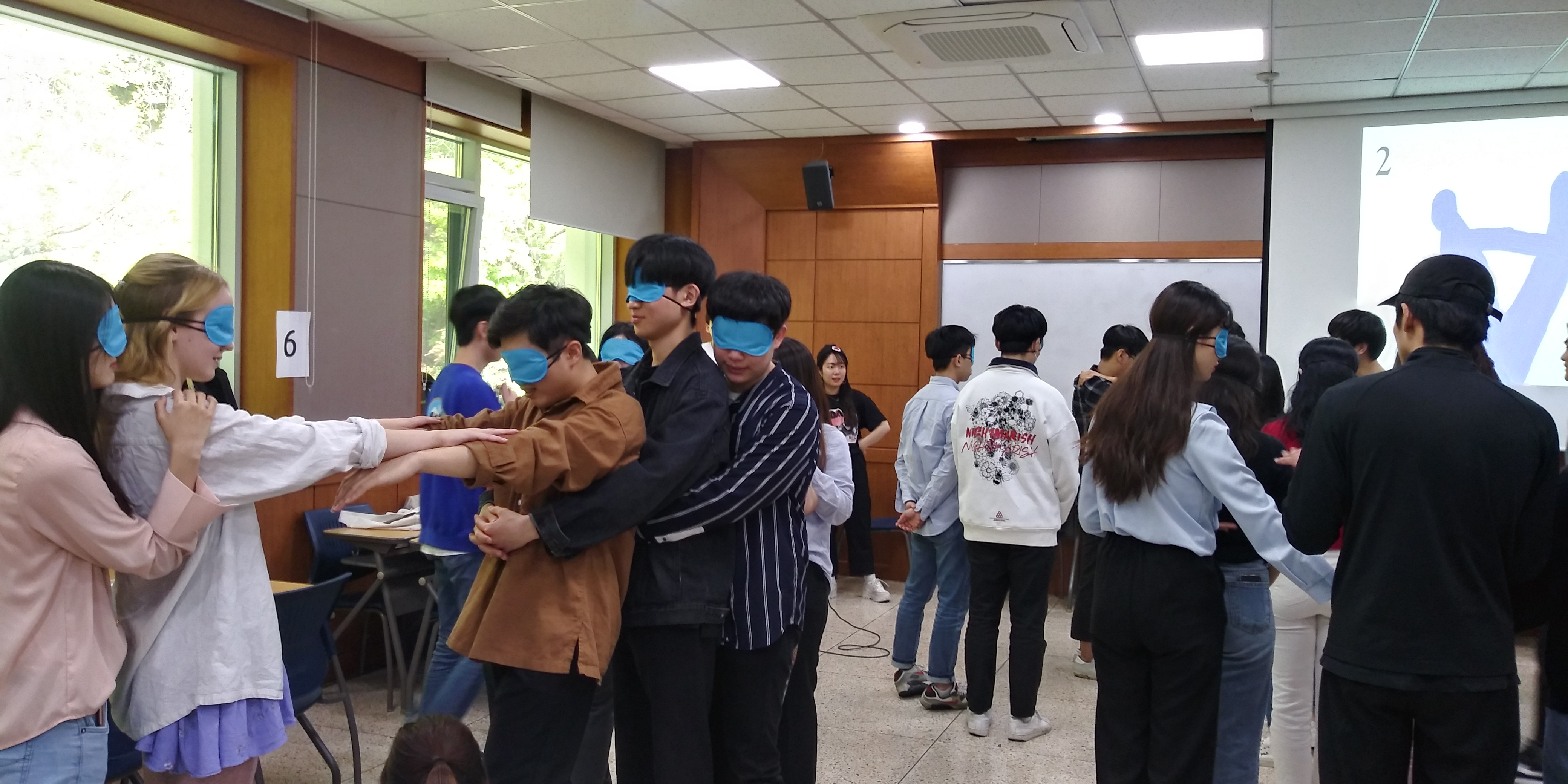
We did a blind mission for our group facilitation . We came up this idea when we go through chapter 6 of People skills book. Since the main topic of the chapter 6 was the importance of non- verbals and body language,  we would like to see what could happen when we block one of the most important senses during our group facilitation. There are two things we tried to prove. Firstly, we would like to see how others could communicate one another when they have the barrier of communication. To fulfill the first condition  we made other classmates cover their eyes with bandages which we prepared. Secondly, we wanted to see if the degree of intimacy affects us when we have communication with others. When we feel awkward with others we tend to have hard time with having a conversation. So we tried to prove that this hypothesis could be applicable to this facilitation. To complement this,  at the beginning , we made the classmates form the random group and we let them go back to their usual group.

While we proceeded with our facilitation there were two things that we overlooked. Firstly, we didn’t think about the heat coming from wearing the bandages. Since the weather was quite hot on that day, most of the classmates said it was hot and uncomfortable to wear bandage. And this factor resulted in the low rate of participation. We should have bought the bandage which is more comfortable or done this facilitation in more spacious place where there is air conditioning.  And we overlooked the fact that there would be some people who were reluctant to doing our activity. Although we thought all students would participate in our activity, some of them looked as if they were waiting for the end of our activity.

But there were two things that we could prove through our facilitation. As we expected, the classmates seemed like that they had harder time to direct to their team members when they are in random group. On the other hand, It took shorter time for them to accomplish the mission when they are in their usual group. Through our facilitation we could know that intimacy can be influential when we have a conversation. Because they seemed awkward and uncomfortable with their new team members. I reckon this result can be applicable to work.According to an article, In work if we have just formal or official atmosphere with coworkers or superiors, we won’t speak our opinion freely. But in these days the majority of companies are trying to remove this barriers between them and co- workers by having intimate relationship one another. Through this, the workers seems to speak their thoughts or opinions more freely. Also we could learn lesson that the body language is crucial when we communicate with others in daily life. Not to mention it was more important when they couldn’t rely on one of their major senses. Thanks to this activity, I could realize that i should use the body language more properly to have conversation with others without barriers.

<Reference>

ROBERT BOLTON, PH.D.  PEOPLE SKILLS

http://www.hkbs.co.kr/news/articleView.html?idxno=500408 2019/02/12  < Body language is more than 100 words>

2019/05/13  < Peculiar ways of communicating>

HOW TO KEEP OUR TERRITORY SAFE

Photo by Gratisography on Pexels.com

In chapter 8 and 9 , listening and assertion are the yin and yang of communication, which means they are interdependent and complementary each other. This shape can be applicable in our relationship in our real life. It is crucial to maintain this shape in order to maintain the relationship.

Every single person has their own territory including  person’s possessions such as clothes and particular pieces of furniture. And from time to time we tend to become aggressor who invades or encroaches personal space. Therefore we should keep our emotional distance with others. But as long as we live in a crowded world of imperfect people, we can’t always stop others from intruding our personal space. But assertion is useful tool to defend our space from other people in this world.

Impacting can be classified into submissive behavior , assertive behavior , and aggressive behavior depending on our degree. If we have a lack of self respect, other people will think that we have submissive behavior. And if we are inclined to overpower others, there is good chance that we will behave aggressively. But if we moderate these two things, we can behave assertively. The assertive person utilizes methods of communication which enable her to maintain self respect not giving up on his happiness or satisfaction.

Each behavior has its own benefits and penalties. When it comes to the benefits and penalties of submissive behavior, since other people will think the submissive people are helpless , they tend to help or care of the submissive people. But if the submissive people sacrifice themselves too often in relationship, they got to have less satisfying and intimate relationship with other people. And the submissive people normally repress their feeling , it is possible that they get stressed or sick.

In terms of the benefits and penalties of aggressive behavior, aggressive people tend to control others in the relationship and make others do what they want because this control is substantially valued for them. But the aggressive behavior can make enemies and makes them more vulnerable and fearful. And the more the people behave aggressively, the more other people will run away from their life.

When it come to the advantages and penalties of assertion, assertive people will feel a lot better than the submissive and aggressive people. And it is indisputable that they can foster fulfilling relationships. But a major contribution of assertion training is that it deals with each of these negative factors. It helps people learn to make more realistic appraisals of the possible consequences of their assertion. In conclusion, if we don’t know what to choose in relationship, the book says the assertive behavior will help us out most of the time.

Main topic of chapter 9 is how to use the assertion effectively in our daily life. When other people invade our territory we should confront with them. To accomplish this successfully, we should send an assertion message  effectively. To send this message effectively, we should combine behavior, feelings and effects

To begin with,  there is non judgemental descriptions of behavior, we should describe the behavior specifically and limit ourselves to behavioral descriptions. And it is better to make our behavior description an objective statement rather than a judgement. And there is  disclosure of feelings. It is prevalent that we are inclined to exaggerate or overstate our feeling in daily life. Since we find it more convincing, we feign stronger emotions. But if we do that, it will end up being counterproductive. So it is important to precise state of feeling that we are experiencing.

In conclusion, if we follow these ways of being assertive in relationship, we can defend our territory effectively from other people  and even if someone invades our territory we can confront them successfully in our daily life. Moreover, following these ways, we might be able to change ourselves and learn many things about ourselves.

Body language is louder than words

Photo by Lukas on Pexels.com


In chapter 6 and 7, it stressed that the importance of body language in communication.35 percent of  the meaning of communication derives from words, which means rest of the meaning of the communication derives from body language. Furthermore Albert Mehrabian stated that  only 7 percent of impact was verbal and the rest of it was nonverbal.

In this chapter, it said that non verbal is the language of feelings. While we have conversation, we can sense the other person’s feeling looking at their nonverbal language. For instance, if the other person get angry, we could see his feeling on his face no matter how hard he tries to hide it. When we communicate with other people we should focus more on the nonverbals than verbals by making a conscious effort to focus our attention on the cues or heightening our awareness of my own feelings about the interaction.  Therefore we could consider the nonverbals the means of communicating emotions.

Three sources of information

When it comes to the visual channel there are three sources of information  that we can read others’ emotion. Firstly there is facial expression. It is obvious that face can disclose our emotion properly while we have conversation with others. And the face is inclined to remember our usual facial expression and project it on our face over time.  For example if someone’s face looks delightful there is the good chance that the person might have joyful life.

Secondly, there is vocal cues. Depending on the emotions, we are apt to speak differently. It is prevalent that emotions such as enthusiasm or anger affect rapidity of speech , volume and pitch. For this reason, effective listeners try to grasp this kind things such as speaker’s  pitch, rate , and subtle nuances more than the speaker’s words.

Lastly there is posture, gestures and actions. Our gestures tend to get affected by our emotions such as self image or energy level. For instance, if we finish the conversation we stretch or bob our legs and prepare for leaving. Since these nonverbals don’t stand alone, we should try to understand them in the context like a word in a paragraph. If we listen to just words or only body language, it will be obvious  that we get distorted impression. Thus, it is beneficial for us to integrate signs from the words and the body language when we communicate with others.

In conclusion, since so much of interpersonal communication is comprised by the nonverbals in daily life, it is indisputable that the reading of body language is paramount skill for effective listening. Body language is apt to ambiguous and unclear. So we should understand others’ nonverbals by focusing attention on the most helpful clues , reading nonverbals in context , noting discrepancies, and being aware of our own feelings and bodily reactions.

How to reinforce our reflection skills

In chapter 7, improving our reflection skills is mainly mentioned.

DON’T FAKE UNDERSTANDING

When you have conversation it is necessary to be candid. If we get lost or don’t understand what the other person says during the conversation, we should stop him in order to ask him to say one more time.

Don’t tell the speaker you know how he feels

You shouldn’t say ‘ I know how you feel’  to be seemed sympathetic with speaker. If you do this there is good chance that the speaker is not able to share details which can help you understand specific speaker’s feeling. Thus if you want to sympathetic with the speaker, you should do this without saying this kind of words.

Vary your responses.

Since there is no right response in conversation, we should try to vary our responses so that we can remove the barrier of interpersonal communication.

Focus on the feelings

There are many aspects that we need to be aware of when we communicate with others. But it is crucial to focus  more on others’ feelings than other aspects

Choose the most accurate feeling word

As this book empathized, emotions are the key element to productive communication. Thus we should find the precise words which can represent our feelings properly so that we can specify the scale of feeling.

Strive for concreteness and relevance

After we listen to what speaker says, we should give concrete solution so that the speaker can resolve their problem clearly. By concreting in his responses and fostering concreteness in a conversation and facilitating more concreteness in a conversation, we can point out the exact gist of the conversation and we can make the speaker lead to the point directly.

After you fulfill these guidelines it is recommendable to do reflective listening. It is beneficial to do reflective listening before you act or you argue or criticize or when the other person is speaking in a code or another persons wants to sort out his feelings and thoughts during a direct mutual conversation.  If you refer the reflective listening skills, you can lead the other to problem- solving procedure, referral and appropriate self disclosure.

In  conclusion, although Listening is the delightful in order to keep it joyful we should be aware of these guidelines which are mentioned in this chapter. If we follow this guidelines it can make us have pleasant conversation in our daily life.

Ways to understand others

Photo by rawpixel.com on Pexels.com

listening skills

According to chapter 3 , 4 and 5  in people skills, we spend most of our waking hours listening. Compared to the fact that writing took 9 percent and reading took 16 minutes, listening absorbed 70 percent.  So it is obvious that we need to improve our listening skills not reading and writing skills. But ironically, we are apt to put our effort on improving reading or writing skills. Even in school, most of teachers teach how to read or write well , which makes students poor listeners.

Listening can be classified into hearing and listening. When it comes to hearing, it is the physiological sensory processes. On the other hand listening  is a more complex psychological procedure involving interpreting and understanding. Speaking of listening there are three necessary skills which are attending skills, following skills and reflecting skills.    

The cluster of listening skills

Firstly, attending is giving your physical attention to another person. In attending skills there are three specific skills such as a posture of involvement, appropriate body motion ,eye contact and non distracting environment.  Because body language often speaks louder than words, It is important to give the impression to other person that you are engaged in the conversation. For example, if you face the other squarely and maintain an open position with arms and legs uncrossed,  the other person will consider you are attentive listener.

Secondly, following skills such as door openers, minimal encourage, open questions and attentive silence can foster effective listening. Door openers is sign or invitation that people send to their friends or spouse. But most people send door closers even if it is necessary to send door openers. And when it comes to questions during communication, there are open questions and closed questions. When people ask closed questions which can be answered with yes or no, these questions can be the barriers of the communication. In contrast to the closed questions, open questions can provide the space for the speaker to think , which can initiate interaction.  

Thirdly, regarding reflecting skills there is paraphrasing, reflecting feelings, reflecting meanings, and summative reflections. Paraphrase is a correct reponse in which the speaker changes words into their own word so that the listener can understand their word easily.  If the speaker paraphrase words effectively, it can help listener focus on the content of the message. Also it is crucial to reflect feelings of the speakers while we have conversation. If we reflect feelings well, we can catch the speaker’s personal reaction such as joy, sorrow, and anger to the certain events. By improving this skill, we can improve the skills which can read the emotions of others. We can train this skill when we listen for feeling words, inferring feelings from the overall content and observing body language. Although the reflection of feeling is the essence of effective listening ,in these days the majority of listeners tend to focus more on the contents than feelings. Thus it is vital for us to foster this reflecting skills in order to participate into conversation and understand speaker properly. Lastly summative reflection is literally summary of the conversation, which can enable the other to speak more profoundly and the speaker to understand his situation clearly. can help tie the loose strands of a conversation

To sum up, since it is indisputable that listening is crucial activity in our waking hours, we need to foster our listening skills based on the three listening skills above. Since it is competitive society in these days, many people are inclined to insist their opinion interrupting others’ word . Furthermore numerous people feel awkward  when they use this skills and they reckon this is too structured. But if they follow six peculiarities of human communication which were mentioned in chapter 5 :, 1. words have different meanings for different people, 2. People often code their messages 3. People frequently talk about presenting problem when another topic is of greater concern to them 4. The speaker may be blind to her emotions or blinded by them. 5. Listeners are often easily distracted 6. Listeners hear through filters that distort much of what is being said ,  this reflective listening can let us have communication with other people more accurately and profoundly. And this will lead us to relate to other people more while we have conversation with others. Thus in order to become good listener, we should respond reflectively to what the speaker says.